Future Projects


I. Expansion of the Refining Base - (Khalifa Coastal Refinery)
Foreseeing the mounting demand of deficit POL products in Pakistan, PARCO in alliance with International Petroleum Investment Company (IPIC) of Abu Dhabi, is endeavouring on a 250,000 bpd deep conversion refinery with a foreign direct investment of US $6 billion, at Khalifa point near Hub in Pakistan’s province of Balochistan. The IPIC and other UAE Government institutions will have the majority of the shareholding i.e. 74% shares in the project, whereas Pak-Arab Refinery Limited (PARCO) will have 26% of the holding.

Importance of Khalifa Point
The development of Khalifa Coastal Refinery at Khalifa Point will be a strategic investment and will play a pivotal role in ornamenting the country’s petroleum affluence. With the construction of marine loading facilities to feed the refinery along with catering to export requirements, Khalifa Point would also develop into another port proficient in handling liquid petroleum cargo. This would be significantly instrumental in supplementing the economic development of Pakistan in general and Balochistan in particular.

Process selection and refinery configuration are based on meeting regional as well as domestic “Middle Distillates” requirements. The refinery will be producing petroleum products of international quality based on “Euro IV” specifications for improving environmental standards besides ensuring the marketability of the products in the international marketplace. Khalifa Coastal Refinery is a deep conversion refinery, designed to process 250,000 bpd, and is being designed to process Heavy Crude which will be procured from adjoining gulf countries like UAE, Iran, and Saudi Arabia etc.

Benefits of Khalifa Coastal Refinery - (KCR)

  • Foreign Direct Investment of about US $6 billion, which is the largest single Foreign Direct Investment (FDI) made in the country so far. This will bolster the much needed economic activity in a relatively less developed area.
  • Improvement of much needed petroleum infrastructure in the country.
  • The deficits of Diesel faced by the country will either be wiped out or reduced to minimal quantities.
  • Strengthen the supply chain integrity of petroleum products in the country.
  • Generate direct and indirect employment during construction as well as the operation phase.
  • Training and development of local human resource through new opportunities and technology transfer.
  • The Human Resource employed for the project will be technically trained and exposed to latest technology.
  • Enhancement of the productivity of local vendor and material supply industry.
  • Another effort of Government and Private sector to bring welfare to the people of Pakistan, especially in Balochistan.
  • Development of other ancillary and support industry around the refinery complex.

II. Clean Environment is a Priority - (Diesel Hydro-Desulphurization Project)
PARCO, over the years, has encouraged and played a pivotal role in minimizing the environmental attrition by introducing unsoiled and environmental friendly fuels since commissioning of the Refinery in September 2000. Diesel Hydrodesulphurization (DHDS) project aims at meeting the International standards by reducing sulphur content in HSD, and is yet another contribution towards protecting the environment. This will be in agreement to Government of Pakistan directive and will reduce sulphur contents in HSD from the present 7000 parts per million to 500 parts per million.

PARCO signed an agreement on Friday, January 25, 2008 with a consortium of China National Chemical Engineering Group Corporation (CNCEC) and Hyundai Engineering Company (HEC) of South Korea for the engineering, procurement and construction of US$ 132 million Diesel Hydrodesulphurization Plant at its 100,000 barrels per day Mid-Country Refinery at Mahmood Kot, Muzaffargarh.

PARCO has always remained an environmentally conscious corporate entity. The company pioneered 87 Octane (2001) and 90 Octane (2003) lead-free gasoline and with the introduction of the new plant PARCO will again take the lead in producing environment-friendly products. The project is expected to be completed in the third quarter of 2010.


III. Adding Value to the Bottom of the Barrel - (Asphalt Production Plant)
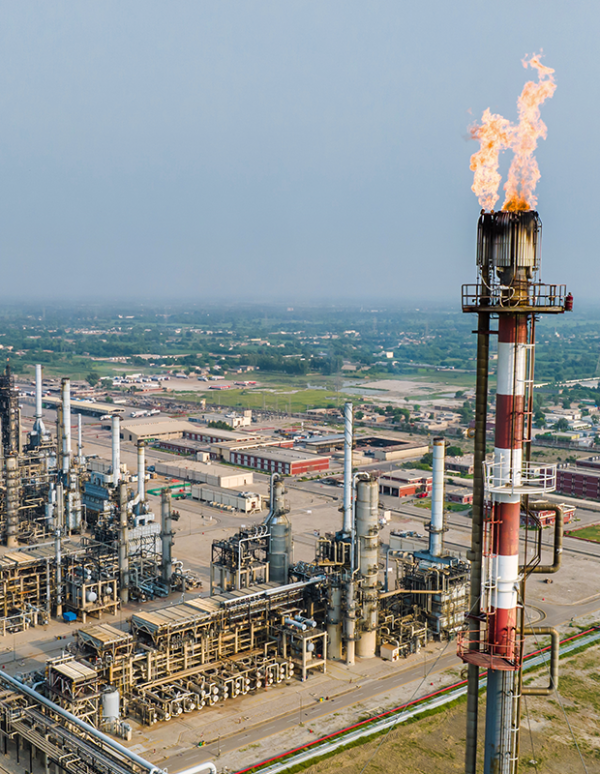
PARCO’s Mid Country Refinery has the ability to produce around 1.2 Million Metric Tons of Furnace Oil at 100% capacity. The Power Plants are the main consumers of Furnace Oil which constitute almost 88%, while General Trade comprises 12% of the market demand. Annual average General Trade demand remains in the range of 70,000 MT/month, while the Power Plants (capable of dual fired system) either have, or are shifting from Furnace Oil to Gas/Coal.

In order to sustain the operation of Mid-Country Refinery at higher throughput, it is evident that all the POL products are uplifted Ex-MCR in a uniform manner. Furnace Oil comprises of approximately 30% yield, therefore the uplifting of Furnace Oil is critical and requires regular stock movement to ensure sufficient ullage to run the Refinery at a higher throughput. The Furnace Oil consumption in Power Sector is a function of availability of Gas and/or production of electricity through hydel power, the monthly variation in the Furnace oil demand varies significantly. Hence, consistent monthly upliftment of FO is necessary for the continuous operation of the Refinery.

Asphalt is produced through oxidation of Furnace Oil and has a substantial market in Pakistan. Production of asphalt provides the necessary flexibility to MCR for diverting its FO during the off-season since the product is low in demand. However, there is also cost benefit to produce asphalt (a value added product) during high demand period depending on the price it fetches in the local market.

The Engineering Design Specification (EDS) package for the Asphalt Plant has been awarded to an international contractor. The plant is designed to produce asphalt of international quality specifications and has the capacity to produce 500 M.Tons/day.